Tarpon Fly Fishing Tips Part 2: How to Cast, Present, Hook, and Fight Tarpon
In Part 1, I covered the preparation side of tarpon fishing – fly selection, hooks, drag settings and getting yourself organized on the bow before the fish show up. Here I want to get into what happens once a tarpon appears: the cast, the presentation, setting the hook, and how to fight one of these fish once you’re connected. It’s where things get exciting, and where most fish are lost.
Casting for Tarpon
Be prepared. Tarpon can be seen from a long way off but can show up unexpectedly so it pays to be ready. Especially if your guide has just spent 5 minutes poling you into the right position for a cast.
Being prepared means that there are no obstructions in the cockpit that fly line can get caught on.
Your drag should be set at about 2 pounds and this should be checked before you are on the bow of the boat. Ask your guide to check it if you are unsure.
Get on the same page as your guide when using the clock system. He will be about 15-18 feet behind you, depending on the size of the skiff or panga, so your 11 will be about his 11:30.
Ask your guide how he would like you stripping the fly once the cast to a tarpon has been made.
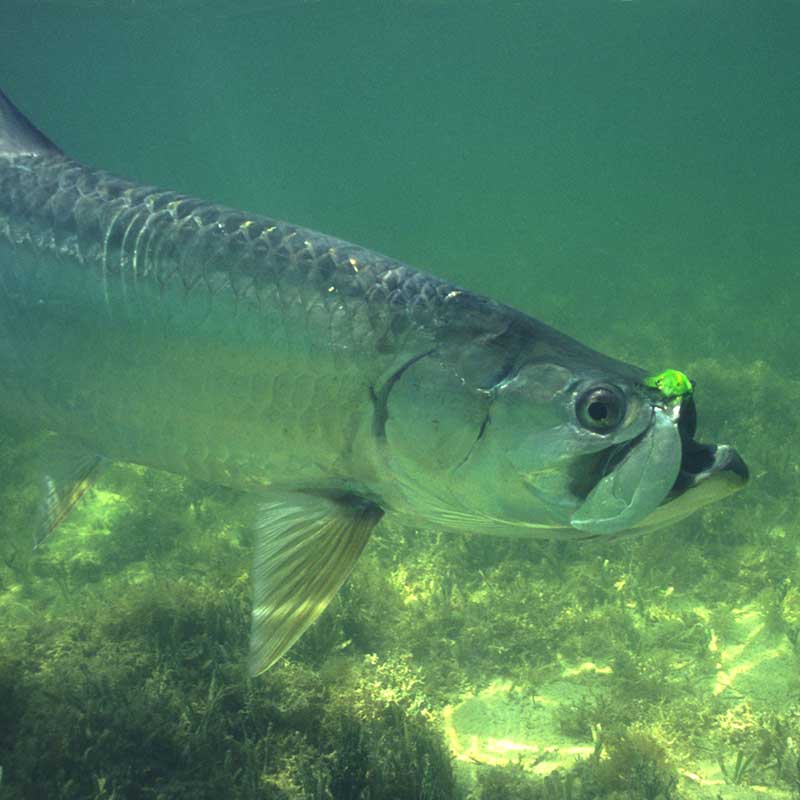
Many anglers, especially those without a lot of tarpon experience, tend not to lead the fish enough, which often leads to spooking the fish. Or leading it too much, where the fish never sees the fly. For cruising fish I like to lead the fish or school of fish by about 10-12 feet. This will allow anglers to either speed up or slow down the fly to get it at the right depth in the water column for the fish to eat the fly with as little effort as possible. For laid up fish in the back country I like to drop the fly about 2 feet in front of the fish. If the fish does not move, I’ll try to drop it right on its nose.
After the Cast
Successful tarpon fishing is really all about the angle of the cast and the retrieve. In most cases, a cruising tarpon on the flats will not deviate much from its swimming path in order to eat the fly. Too far left or right and the fish keeps swimming on. You want to be able to bring the fly eye level with the fish right in its path, or maybe a foot to the left or right.
Make sure your slack is clear as soon as the cast has been made.
Then get your rod tip pointed down to where it’s either just above the water or just touching the water.
Listen to your guide and retrieve the fly based on his instructions. Because he is elevated he will most likely be able to see the fly better than you. And he may give you different instructions than what you expect, based on where the fly is and what the fish is doing. DON’T QUESTION IT. JUST DO WHAT HE ASKS!!!
SETTING THE HOOK
Strip set the hook when you feel pressure. As hard as you can. Then transfer the hook set to your rod, in a low sideways motion, away from the direction of the fish. At the same time, keep using your stripping hand to help further set the hook.
In a perfect world, I’m trying to stick the fish in a series of three or four hard jabs with the rod and my stripping hand, in order to bury the hook. A tarpon’s mouth is a combination of rock hard cartilage and bone and trying to get a good hookset is like trying to bury a hook into a dinner plate.
After the Eat
A 100 pound tarpon can get 200 yards into your backing in the blink of an eye. The power of these fish when connected to your fly line is an adrenaline rush that is hard to explain. It’s easy to just watch the fish peel off backing as it leaps 6 feet into the air, thrashing wildly. But you can’t just watch, because you have work to do.
Your number one priority once the fish has eaten your fly and started to run is to clear your line through the line guides and to get that fish onto your reel. Line can get tangled and knotted or jump around the butt end of your rod, creating instant bust off and severe self-loathing. Use your stripping hand to feed/guide the line through the guides so that you have the fish on the reel as soon as is possible.
When the tarpon clears the water you will need to lean forward and punch your rod as far out as you can in the direction of the airborne fish. Many anglers call it “Bowing to the King”, but you aren’t really bowing the rod at all. The key to the whole process of pushing the rod out and forward to the fish to ensure that the tarpon’s full weight does not come tight against the leader. Experienced tarpon anglers can anticipate when a tarpon is about to go airborne and the more you do it, the better your timing will become. It’s really important to be pushing your rod forward as the fish starts his leap, as opposed to once it’s fully out of the water. Timing and anticipation are the key and the more you do it the better you get at it.
As you reel in backing it’s really important to make sure that the backing is evenly dispersed as it goes back onto the reel. Too much on one side or the other and it creates a situation where it can bind into itself and cause breakoffs. Use your trigger finger to evenly spread out the backing as you are retrieving.
Tarpon are incredibly powerful fish and it’s a real battle to tire them out. Anglers need to be constantly applying pressure on the fish at all times during the fight. To do this you need to be keeping your rod down and at an angle, at your side. If the fish is pulling left, you need to be pulling right and vice versa. The rod needs to be low and to the side. Not up and down. This “down and dirty” method of rod placement when fighting a tarpon is tried and true and it’s the only way to tire out a big fish. You always want to be pulling in the opposite direction that the fish wants to go.
Rookie Mistakes
By far the majority of tarpon are lost when inexperienced tarpon anglers try to set the hook with their rod and not with a strip set. DO NOT TROUT SET ON A TARPON!
Make sure your hands are completely free of sun screen or other oily products. A greasy hand cannot get a good strip set.
Make sure you lead the fish sufficiently. A 6 foot long hundred pound tarpon will usually spook when you drop the fly on its head in clear water. Leading the fish sufficiently will allow the angler enough time to get the fly in front of the fish’s swimming path and at the right level in the water column.
Listen to your guide. Each tarpon location has its own unique characteristics and just because something worked in Southern Belize does not mean that it will work in the Florida Keys or Cuba. Listen to your guide!
Looking for part 1 of this story – find it here
Tarpon Availability
We have tarpon destinations available across Mexico, Central America, the Caribbean and beyond. Give us a call at 1-866-644-7703 or reach out over email at [email protected] and we’ll find the right fit for you.